Best Acoustic Treatment Panels for a Home Studio (Seven Options)
The best acoustic treatment panel for a home studio is the ATS Acoustics 2 inch panel at $79.95, a 24 by 48 inch fabric-wrapped rigid fiberglass absorber that works down into the low mids rather than only taking the edge off the top. Buy four for the first reflection points, and buy corner traps such as the Auralex LENRD pack at $106.99 before buying more wall panels, because a corner is where every room mode has a pressure maximum.
Definition: An acoustic panel is a porous absorber that converts sound energy into heat as air moves through its fibres, which makes it effective at frequencies whose quarter wavelength is comparable to the panel thickness and largely ineffective below that.
The best acoustic treatment panel is the ATS Acoustics 2 inch panel at $79.95, because it is rigid fiberglass rather than foam and that difference decides whether a panel works below 500 Hz or only above it. Buy four for your first reflection points, and buy corner absorption like the Auralex LENRD pack at $106.99 before you buy any more wall panels.
Acoustic treatment is the only category on this site where the physics is not a matter of taste. A porous absorber does what its absorption coefficient says it does. That makes it easy to recommend honestly and easy to check, which is unusual, and it also means the marketing on some of these products can be tested against the numbers rather than argued about.
How does an acoustic panel actually work?
By friction. Sound is moving air, and when that air moves through a fibrous material it loses energy to friction and gets converted to a tiny amount of heat. That is the whole mechanism. It is why density and thickness are the specifications that matter and why a hard, shiny panel absorbs nothing regardless of what it is made from.
The critical consequence is that a porous absorber works on air velocity, not on pressure. Right at a wall, air velocity is zero: the wall stops it. Velocity reaches a maximum a quarter wavelength away. Wavelength is speed divided by frequency, and the speed of sound is about 1130 ft/s, so:
- At 1000 Hz, wavelength is 1.13 ft and a quarter wavelength is 3.4 inches. A 2 inch panel is well placed.
- At 250 Hz, wavelength is 4.52 ft and a quarter wavelength is 13.6 inches. A 2 inch panel is doing partial work.
- At 100 Hz, wavelength is 11.3 ft and a quarter wavelength is 2.8 feet. A 2 inch panel flat on a wall is nearly irrelevant.
That single fact explains everything else on this page: why bass traps go in corners rather than flat on walls, why gapping a panel off the wall helps, and why foam wedges are not bass traps.
Which acoustic panels should you buy?
Three tiers. The beginner tier is foam, which is cheap and genuinely limited. The intermediate tier is rigid fiberglass, which is where treatment starts working, and where nearly everyone should spend. The expert tier is finished panels and complete kits, and the section below says who should not pay that premium.
Acoustic treatment picks, beginner to expert

Corner bass trap foam, 12 pack
Twelve corner wedges for $21.99. This needs saying plainly: foam this size does very little below about 200 Hz, so calling them bass traps is generous. They take the harsh flutter off a small room and nothing more.
Best for: A first pass on a bedroom, with realistic expectations about the low end.
Check price
Auralex Studiofoam Wedgies, 24 panels
Twenty four foam panels, which is enough to cover a meaningful share of a small room. Foam absorbs strongly above about 500 Hz and progressively less below it, so this fixes flutter echo and vocal harshness without touching a single room mode.
Best for: Killing flutter echo and slap in a bright, empty room.
Check price
ATS Acoustics 2 in panel, 24 x 48 in
Two inches of rigid fiberglass in a fabric frame, 24 by 48 inches. This is genuine broadband absorption rather than foam, and it is the panel to buy for the four first reflection points that actually change what you hear.
Best for: The first reflection points, which is where treatment starts working.
Check price
ATS rigid fiberglass board, 2 in, case of 6
Six sheets of bare 2 inch rigid fiberglass for $124.99, which is far less per panel than a finished frame. You supply the frame, the fabric and an afternoon. This is how you treat a whole room without spending four hundred dollars.
Best for: Anyone willing to build frames, which is most of the value in treatment.
Check price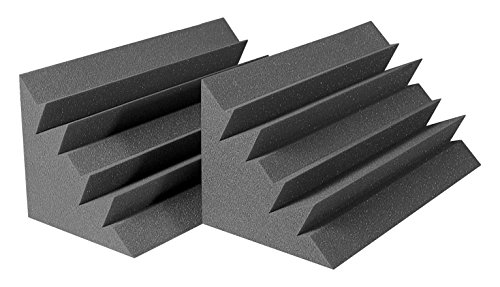
Auralex LENRD bass traps, pack of 2
Twenty four inches of dense foam straddled diagonally across a corner does reach lower than a flat panel on a wall, because a corner is where low frequency pressure is highest and the diagonal mounting puts real depth of material into the path.
Best for: Tightening up a boomy small room, and the first purchase to make.
Check price
Auralex ProPanel B224, 2 x 4 ft
A 2 by 4 foot fabric-wrapped panel built to be mounted and looked at, with the mounting hardware designed in. You are paying a substantial premium over the ATS panel for finish and for hardware that works first time.
Best for: A room other people see, where a bare fiberglass board is not acceptable.
Check price
Primacoustic London 8 room kit
Eight panels plus the mounting hardware, sized and specified as a set for a small control room. The premium over loose panels buys you a plan rather than a pile, and a plan is what most people are actually missing.
Best for: Treating a whole room in one purchase without designing the layout yourself.
Check pricePrices change often, confirm on Amazon. As an Amazon Associate we earn from qualifying purchases.
How much does each material absorb?
Absorption coefficients run from 0 to about 1, where 1 means all the energy hitting the material is absorbed. These are representative figures for the material types rather than measurements of the specific listings, and the shape of each row is the part that matters.
| Material | 125 Hz | 250 Hz | 500 Hz | 1 kHz | 4 kHz |
|---|---|---|---|---|---|
| 2 in acoustic foam | 0.10 | 0.25 | 0.60 | 0.85 | 0.95 |
| 2 in rigid fiberglass | 0.20 | 0.55 | 0.90 | 1.00 | 1.00 |
| 2 in rigid fiberglass, 2 in gap | 0.35 | 0.75 | 0.98 | 1.00 | 1.00 |
| 4 in rigid fiberglass | 0.45 | 0.90 | 1.00 | 1.00 | 1.00 |
| Bare painted drywall | 0.10 | 0.08 | 0.05 | 0.03 | 0.03 |
Read the 125 Hz column. Foam at 0.10 is barely distinguishable from the bare wall it is stuck to. Two inch fiberglass doubles that, and gapping it two inches off the wall gets you to 0.35, which is most of what a 4 inch panel achieves mounted flat. Gapping is free and almost nobody does it. The full material comparison is in foam versus rockwool.
Where do the panels go, in what order?
Placement decides more than product choice, and the order is not negotiable.
- Corners, floor to ceiling, front wall first. Every room mode has a pressure maximum in a corner, so absorption there works on all of them at once. This is the purchase nobody wants to make because a bass trap is not a satisfying thing to unbox, and it is the one that changes the most.
- First reflection points on the side walls. Found with a mirror: sit in the listening position, have someone slide a mirror along the wall at ear height, and put a panel wherever you can see a tweeter. These reflections arrive within a few milliseconds of the direct sound and comb filter it, which is what damages the stereo image.
- The ceiling above and slightly in front of the listening position. The largest untreated surface in most rooms, arriving earliest of all, and almost nobody treats it.
- The wall behind the listening position. A late reflection off the rear wall returns to your ears delayed enough to smear detail.
Run your dimensions through the room mode calculator to see which frequencies your room concentrates, size the coverage with the acoustic treatment calculator, and check your figures against the treatment coverage chart and the room modes by dimension chart.
The mix that taught me this lesson fell apart in a car. It sounded balanced at my desk and the bass was simply gone on the road, and I spent a week assuming I had a monitor problem. What I actually had was a modal null at the mix position: the room was subtracting energy right where my head was, so I kept adding low end to compensate until there was far too much of it everywhere else. Two corner traps and a proper listening position at about 38 percent of the room length fixed a problem that no amount of EQ was ever going to reach, because the cancellation was in the room and not in the file. If your mixes are consistently wrong in the same direction, suspect the room before the speakers.
Should you build panels or buy them?
Build, if you have an afternoon. The ATS rigid fiberglass board case of six at $124.99 is the same absorbing material as the finished panels at a small fraction of the cost per square foot. What you supply is a simple timber frame, breathable fabric and staples. The material inside a $79.95 finished panel and a $20.83 bare board is not different.
Buy finished panels if the room is shared, visible, or if a stack of bare boards would end the project before it starts. That is a real consideration and not a soft one: treatment that never gets installed absorbs nothing. The Auralex ProPanel and the Primacoustic London 8 kit both exist to solve that problem rather than an acoustic one.
Whichever route you take, use mounting hardware that lets you gap the panel a couple of inches off the wall. That gap is the single cheapest improvement in low frequency performance available to you.
Who should not buy the expert tier?
Do not buy the Primacoustic London 8 room kit at $449.99 if you are willing to build. The same $449.99 spent on rigid board buys roughly three cases, which is eighteen panels of absorbing material, against the kit's eight. If you will actually build the frames, the DIY route treats more than twice the surface area for the same money, and surface area is what determines the outcome.
Do not buy the Auralex ProPanel at $197.85 for a room nobody sees. Its advantage over the ATS panel at $79.95 is finish and mounting hardware, not absorption. In a spare bedroom with the door closed, that is $117.90 per panel spent on appearance, and the same money buys a second panel plus corner absorption.
The kits and finished panels are the right purchase for exactly one reader: someone who will not build, needs the room to look presentable, and wants a plan rather than a pile of parts. If that is you, they are worth every dollar, because the alternative is a project that stalls.
What treatment cannot do
It cannot stop sound leaving the room. Treatment and soundproofing are different problems with different physics: treatment controls reflections inside the space with light porous material, while stopping transmission requires mass, decoupling and airtight sealing. Hanging every panel on this page will not reduce what your neighbours hear by any measurable amount. Read treatment versus soundproofing before you spend, and how to soundproof a home studio if transmission is the actual problem.
It also cannot rescue a bad listening position. If your head sits in a modal null, absorption reduces the depth of the null and does not remove it, so move the chair before you buy anything. The speaker placement calculator and how to position studio monitors cover that for free.
What to buy first, in order
If you have $107, buy corner traps. If you have $320, buy corner traps and four 2 inch panels . If you have $450 and a free afternoon, buy corner traps and two cases of rigid board and build eight panels. That last option treats more room than anything else on this page for the money.
Then check what you built against the room treatment guide, and only afterwards consider whether your monitors are the limiting factor. In an untreated room they never are. The small room monitor roundup and the intermediate build put the two halves together with running totals.
Full review of the room kit
The Primacoustic London 8 review covers what a finished wall panel kit fixes, what it cannot touch, and why the answer to a boomy room is depth in the corners rather than more panels on the walls.
Frequently asked questions
What are the best acoustic treatment panels?
The ATS Acoustics 2 inch panel at $79.95 for a 24 by 48 inch fabric-wrapped rigid fiberglass panel. It is genuine broadband absorption rather than foam, which means it works down into the low mids instead of only taking the edge off the top. Buy four for your first reflection points before buying anything else, and add corner traps before adding more wall panels.
Does acoustic foam actually work?
Above about 500 Hz, yes, and below about 200 Hz, barely. Foam is thin and low density, and a porous absorber only works on frequencies whose quarter wavelength is comparable to its thickness. Two inches of foam handles flutter echo and vocal harshness well. It does not touch room modes, and every listing that calls a two inch wedge a bass trap is being generous.
Where do acoustic panels go first?
Corners, then the first reflection points, then the ceiling above the listening position. Corners come first because every room mode has a pressure maximum there, so absorption in a corner works on all of them at once. Find reflection points with a mirror: sit in the listening position, slide a mirror along the side wall at ear height, and put a panel wherever you can see a tweeter.
How thick do acoustic panels need to be?
Two inches is the practical minimum and four inches is meaningfully better below 250 Hz. A porous absorber does most of its work at a quarter wavelength from the wall, and at 100 Hz a quarter wavelength is about 2.8 feet, which no panel is. The cheap workaround is gapping: mounting a 2 inch panel two inches off the wall lifts its 125 Hz absorption from roughly 0.20 to 0.35.
How much of the room needs to be covered?
Between 20 and 30 percent of the total wall and ceiling surface for a mixing room, concentrated rather than spread evenly. Four first reflection points, two front corners floor to ceiling, one cloud above the desk and the wall behind the listening position accounts for most of it. Spreading the same area thinly across every surface does much less, because reflection points are specific.
Is acoustic treatment the same as soundproofing?
No, and confusing them is the most expensive mistake in this category. Treatment controls reflections inside the room and uses light porous material. Soundproofing stops sound passing through a wall and requires mass, decoupling and airtight sealing. Hanging foam on a wall does nothing whatsoever for your neighbours, and a soundproofed room with bare walls still sounds terrible.
Working out your own room and signal chain? The Home Studio Build Planner is the paid version of these pages: 8 printable worksheets you fill in with your own numbers, plus the full PDF, $29.