Best Dynamic Microphone for Untreated Rooms (Six Picks)
The best dynamic microphone for an untreated room is the Shure SM7B at $439.00, because a tight cardioid pattern worked at three to four inches makes the direct sound far louder than any room reflection. It publishes about 1.12 mV per pascal, so it needs 60 to 65 dB of clean preamp gain and many budget interfaces stop at 50 to 56 dB. The Shure SM58 at $109.00 does most of the same job with an output any interface can drive.
Definition: A dynamic microphone rejects an untreated room not because of its capsule technology but because its low sensitivity forces you to work it at three or four inches, where the direct sound is far louder than any reflection arriving from a wall.
The best dynamic microphone for an untreated room is the Shure SM7B at $439.00, with one condition attached that decides whether you will be happy: it needs 60 to 65 dB of clean preamp gain, and plenty of interfaces stop at 50 to 56 dB. If your preamp cannot feed it, the Shure SM58 at $109.00 gets you most of the room rejection with an output any interface drives comfortably.
The reason this category exists at all is a physical one that no plugin addresses. A bare rectangular room sends a copy of your voice back at the microphone a few milliseconds after the original. Your ear fuses the two rather than hearing an echo, and what you get instead is comb filtering: a hollow, phasey quality that moves whenever the singer moves. A dynamic worked close does not remove those reflections. It buries them.
Why does a dynamic microphone reject the room?
Two reasons, and the second is far larger than the first.
The pattern. A cardioid capsule is roughly 6 dB down at 90 degrees off axis and deeply attenuated directly behind. A supercardioid like the Beyerdynamic TG I51 has a narrower front lobe still, at the cost of a small rear pickup lobe. The polar pattern chart shows where each pattern is deaf, which is what you aim at the problem.
The working distance, which does the real work. A dynamic has low output, so you have to get close to reach a level. The inverse square law says sound pressure falls 6 dB every time distance doubles. Move from three inches to six inches and you lose 6 dB. But the reflection off a wall six feet behind you barely changes, because six feet doubled is twelve feet and the geometry is nearly the same wherever you stand. So working close raises the direct sound relative to the room by a huge margin, and that margin is the entire trick.
A condenser used at eighteen inches for a natural sound gives all of that away. That is the real reason engineers reach for a dynamic in a bad room, and it is why condenser versus dynamic is fundamentally a question about your room rather than about your voice.
Which dynamic microphone should you buy?
Three tiers. The beginner tier is where you should probably start, because a bare room punishes expensive microphones more than cheap ones. The intermediate tier solves specific problems: a very live room, or an interface without enough gain. The expert tier is where the reference answers live, and the section below the cards names who should not go there.
Dynamic microphone picks, beginner to expert

Rode PodMic
An internally shock mounted dynamic with a built-in pop filter and a voicing aimed squarely at speech. At $85.00 it is the least expensive way to get a close, dry, room-free vocal, and its output is low enough that gain is still the thing to check.
Best for: Spoken word, podcasting and voiceover in a bare room.
Check price
Shure SM58
A cardioid dynamic with a built-in ball windscreen and an output high enough that any interface drives it comfortably. It is not exotic and it will make a usable vocal in a room where a condenser would not. Effectively unbreakable.
Best for: A first vocal microphone in a room with bare parallel walls.
Check price
Beyerdynamic TG I51
A supercardioid dynamic, which has a narrower front lobe than a cardioid and a small rear lobe. That narrower acceptance angle rejects more of the room, at the cost of demanding that the performer stay on axis.
Best for: A very live room, or a source next to another loud source.
Check price
Shure MV7+
A dynamic with both XLR and USB outputs and onboard processing, so the 60 dB gain requirement that stops people using an SM7B is handled inside the microphone. It is a real workflow answer rather than a compromise.
Best for: Anyone whose interface does not have enough clean gain and who does not want another box.
Check price
Shure SM7B
The reference answer for voice in an untreated space: a tight cardioid pattern, internal shock mounting, a switchable bass roll-off and presence lift, and a windscreen that lets you work extremely close. The catch is that it needs 60 to 65 dB of clean gain.
Best for: Voice in an untreated room, with a preamp that can actually feed it.
Check price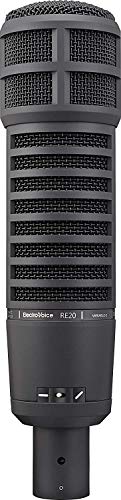
Electro-Voice RE20
Electro-Voice built a variable-D design that largely cancels proximity effect, so a performer can move from two inches to twelve without the low end swelling and collapsing. That consistency is the reason broadcast rooms standardised on it.
Best for: A performer who moves, and for bass amps and kick drums.
Check pricePrices change often, confirm on Amazon. As an Amazon Associate we earn from qualifying purchases.
How much preamp gain does each one need?
This is the table that decides whether your purchase works. Sensitivity is published in millivolts per pascal, and the lower the number the more gain you need.
| Microphone | Price | Pattern | Gain needed | Body controls | Booster likely |
|---|---|---|---|---|---|
| Rode PodMic | $85.00 | Cardioid | 55 to 60 dB | None | Sometimes |
| Shure SM58 | $109.00 | Cardioid | 50 to 60 dB | None | Rarely |
| Beyerdynamic TG I51 | $169.99 | Supercardioid | 50 to 60 dB | None | Rarely |
| Shure MV7+ | $299.00 | Cardioid | 0 dB over USB | Onboard DSP | No |
| Shure SM7B | $439.00 | Cardioid | 60 to 65 dB | Bass roll-off, presence lift | Often |
| Electro-Voice RE20 | $449.00 | Cardioid, variable-D | 55 to 65 dB | Bass roll-off | Often |
Fourth generation Focusrite Scarlett preamps publish 69 dB, which clears every row here. Plenty of older and cheaper boxes stop at 50 to 56 dB, and at that point you are running the preamp wide open, hearing its own hiss under every quiet passage, and blaming the microphone. Put your combination into the gain staging calculator before you order, and check what your interface publishes in the interface database.
What fixes a preamp that runs out of gain?
An inline booster, and it is a better purchase than a new interface. A Cloudlifter CL-1 at $160.10 or a Triton Audio FetHead at $74.95 adds around 25 dB of clean gain right at the microphone, before the cable run. Both are powered from the interface's 48 volt phantom supply and both are entirely passive from the user's point of view: plug in, and your preamp suddenly has 25 dB more headroom.
Boosting at the microphone rather than at the preamp also lowers the noise you end up with, since the signal is larger before it travels down the cable and before the preamp's own noise floor is added. The FetHead is the cheaper of the two, sits directly on the microphone body, and does the same job for less than half the money.
The most common way I see an SM7B disappoint someone is not tone, it is gain. They plug it into a budget interface, run the preamp to its stop, get a level that meters around -25 dBFS, and hear a bed of hiss under the take that no amount of processing removes convincingly. Then they decide the microphone is overrated. It is not overrated, it is underfed. Before buying one, look up the maximum gain your interface publishes. If the figure is under about 60 dB, budget for a FetHead in the same order or buy the SM58 instead and put the difference into a panel behind where you sing. Nobody has ever regretted the panel.
How close should you work a dynamic microphone?
Three to four inches for speech and most close vocal work, and this is not a stylistic preference. It is how the microphone achieves the room rejection you bought it for. Working further back gives up level, which forces more preamp gain, which raises the noise floor and the room at the same time.
The consequence is proximity effect: a directional microphone worked close produces a substantial low frequency boost. On a thin voice that is flattering and is exactly why broadcast sounds the way it does. On a full voice it muddies quickly, and the fix is the bass roll-off switch on the SM7B body rather than EQ afterwards. The RE20 is the exception: its variable-D design largely cancels proximity effect, so a performer can move from two inches to twelve without the tone collapsing.
Plosives get worse the closer you work. The SM7B and PodMic both ship with substantial windscreens for this reason. For anything without one, add a pop filter two inches in front of the capsule and angle the microphone slightly off the mouth rather than straight at it.
Who should not buy the expert tier?
Do not buy the SM7B at $439.00 if your interface publishes less than about 60 dB of gain and you are not also buying a booster. That combination is the single most common disappointment in home recording, and the resulting hissy take is not something you can fix later. Either budget another $74.95 for a FetHead , or buy the Shure MV7+ at $299.00, which solves the gain problem inside the microphone.
Do not buy the RE20 at $449.00 for a singer who stands still. Its defining feature is proximity effect cancellation, which matters enormously for a broadcaster who leans in and out of frame all day and matters very little for a vocalist on a fixed stand. You would be paying a $10 premium over the SM7B for a feature you will not use, and giving up the SM7B's presence lift switch to get it.
And the broader point: the difference between the SM58 and the SM7B is $330.00. That buys three corner trap packs , and corner absorption changes every recording you ever make in that room while a better dynamic changes the vocals only. Size the coverage with the acoustic treatment calculator and read treatment versus soundproofing before spending, because those are different problems with different solutions.
What else the setup needs
A dynamic microphone at three inches puts real demands on the stand, because at that distance any movement is a tone change. A Rode PSA1+ boom arm at $139.99 holds position, decouples from floor vibration and includes an XLR cable. Heavier microphones like the SM7B and RE20 need an arm rated to carry them, which is covered in the stands and boom arms roundup.
No phantom power is required by any dynamic here, though leaving 48 volts on does no harm to a balanced dynamic and is required if you add a Cloudlifter . For the rest of the chain: the interface roundup for the preamp gain question, the tracking headphone roundup so the cue mix does not leak into the take, and how to record vocals at home for the session itself. If your room does get treated later, the vocal condenser roundup is where you go next.
Full reviews of the dynamics on this page
The Shure SM7B review works through the gain requirement in detail, because that is the part that turns a $439 microphone into a $600 purchase. The Electro-Voice RE20 review covers Variable-D and why it makes the RE20 the better choice with guests who move. The Shure MV7+ review covers the one that supplies its own gain over USB and removes the interface question entirely.
Frequently asked questions
What is the best dynamic microphone for an untreated room?
The Shure SM7B at $439.00. A tight cardioid pattern, internal shock mounting and a windscreen designed for very close work mean the direct sound arrives far louder than any room reflection. The condition attached is real: it publishes about 1.12 mV per pascal, so it needs 60 to 65 dB of clean preamp gain, and many budget interfaces stop at 50 to 56 dB.
Why do dynamic microphones reject room sound better than condensers?
Partly the pattern and mostly the working distance. A dynamic has low sensitivity, so you have to work it at three or four inches to get a level, and the inverse square law means level drops 6 dB every time distance doubles. At three inches the direct sound is dramatically louder than a reflection off a wall six feet away. A condenser used at eighteen inches gives that advantage away.
Does an SM7B need a Cloudlifter?
Only if your interface cannot supply 60 to 65 dB of clean gain. Fourth generation Focusrite Scarlett preamps publish 69 dB and clear it without help. Older or cheaper interfaces commonly stop at 50 to 56 dB, and there you are running the preamp at maximum and hearing hiss under every quiet passage. An inline booster adds about 25 dB of clean gain right at the microphone.
Is a dynamic microphone worse quality than a condenser?
It is less detailed and less extended at the top, and in an untreated room that is a feature rather than a fault. What a condenser captures with its extra sensitivity is partly the source and partly the wall behind it. A dynamic gives up some air above 12 kHz and in exchange gives you a vocal you can actually mix, without a phasey comb filtered room printed underneath it.
What is proximity effect and does it matter?
Proximity effect is the low frequency boost a directional microphone produces as you get close to it, caused by the pressure gradient design. Worked at two inches an SM7B can add a great deal of weight, which flatters a thin voice and muddies a full one. The Electro-Voice RE20 uses a variable-D design that largely cancels it, so the tone stays consistent as the performer moves.
Should I buy a dynamic microphone or treat my room?
Do both, in that order, because the microphone is the cheaper half and gets you recording immediately. A Shure SM58 at $109.00 makes a usable vocal in a bare room today. Two corner bass traps and two first reflection panels then change every recording you make afterwards, including the ones with a dynamic. Treatment is what eventually lets you use a condenser at all.
Working out your own room and signal chain? The Home Studio Build Planner is the paid version of these pages: 8 printable worksheets you fill in with your own numbers, plus the full PDF, $29.