Best Microphone Stands and Boom Arms (Eight Picks)
The best microphone stand for most home studios is the On-Stage MS7701B euro boom at about $31.95, because the counterweighted boom balances the load instead of cantilevering it and therefore holds position with a heavy microphone at full extension. If you record voice seated at a desk, a clamped boom arm such as the Rode PSA1+ at $139.99 is the better buy, because it also isolates the microphone from footfall coming up through the floor.
Definition: A microphone stand is a mechanical support whose job is to hold a chosen microphone position without moving and without transmitting structural vibration to the capsule, which makes mass and boom balance the two specifications that matter.
The best microphone stand for most home studios is the On-Stage MS7701B euro boom at about $31.95, because a euro boom is counterweighted and an ordinary boom is not. If you record voice sitting at a desk, buy a Rode PSA1+ at $139.99 instead, since a clamped arm also removes footfall from the equation.
This is the category nobody researches and almost everybody replaces. A stand has exactly one job: hold a microphone in a position you chose, without moving, and without carrying floor vibration into the capsule. Both failures show up on the recording rather than in the room, which is why they get blamed on the microphone.
Why do cheap microphone stands droop?
Because a boom arm is a lever, and the load on the clutch is torque rather than weight. Torque is the weight of the microphone multiplied by its horizontal distance from the pivot, so the same microphone twice as far out loads the clutch twice as hard.
| Microphone | Weight | At 12 in | At 24 in | At 36 in |
|---|---|---|---|---|
| SM57 dynamic | 0.63 lb | 7.6 | 15.1 | 22.7 |
| AT2035 condenser, no mount | 0.90 lb | 10.8 | 21.6 | 32.4 |
| Condenser plus shock mount | 1.50 lb | 18.0 | 36.0 | 54.0 |
| SM7B with yoke | 1.69 lb | 20.3 | 40.6 | 60.8 |
| Large multi-pattern in mount | 2.20 lb | 26.4 | 52.8 | 79.2 |
A light tripod boom is comfortable in the top left of that table and struggling in the bottom right. The fix is not a tighter clutch, which strips the threads and still slips. The fix is either less extension, a counterweight, or a heavier base, and the euro boom design gives you the second of those for a few dollars.
A euro boom puts the counterweight on the short end of the arm, inside the tripod footprint. That does two useful things at once: it cancels most of the torque at the clutch, and it keeps the centre of mass over the legs so the whole stand does not want to tip. It also stops the counterweight end from sticking out into the room at shin height, which is the reason the design exists at all.
Which microphone stand should you buy?
Three tiers, and the honest position is that the intermediate tier is where nearly everyone should land. The beginner tier works and has a real weight ceiling. The expert tier buys metal clutches and cast mass rather than any acoustic improvement, and the section below says who should not pay for it.
Microphone stand and boom arm picks, beginner to expert

Tripod boom microphone stand
A tripod boom at $26.98 that will hold a 1 pound condenser at a moderate boom extension without creeping. Extend it fully with a heavy microphone on the end and it will sag, because there is no counterweight to balance the lever.
Best for: A first stand, a spare, and any microphone under about a pound.
Check price
On-Stage MS7201B round base stand
A round base rather than a tripod, which means it fits against a wall, under a desk and inside a vocal booth where three splayed legs will not. The tradeoff is that the whole stability budget is the weight of the base, so it does not take a boom well.
Best for: Straight vocal position in a tight space, and anywhere legs would be a trip hazard.
Check price
On-Stage MS7701B euro boom stand
A euro boom, which means the boom arm has a counterweight end that stays inside the tripod footprint. That geometry is the whole point: the load is balanced rather than cantilevered, so the stand holds position with a heavy microphone out at full extension.
Best for: Nearly everything. Vocals, amps, acoustic guitar, drum overheads at a stretch.
Check price
Gator Frameworks weighted desktop stand with boom
A genuinely weighted base with a short boom, which is a different product from the light desk tripods that come bundled with microphones. Heavy enough to stay put when a cable is tugged, low enough to stay out of a camera frame.
Best for: Seated voice work at a desk where a boom arm cannot be clamped.
Check price
Rode PSA1+ boom arm, with XLR cable
Internal springs rather than external, so it holds position across the whole range instead of only in the middle of it, and the XLR cable routes inside the arm. Clamps to a desk, so it decouples the microphone from the floor entirely.
Best for: Anyone recording voice at a desk, which is most home studios.
Check price
Elgato Wave Mic Arm LP, low profile
The arm parks below the desk line and rises into position, so a microphone can sit in front of a face without crossing a screen or a camera. That is a workspace solution rather than an acoustic one, and it is the reason to pay for it.
Best for: A desk with a monitor arm already on it, or anyone on camera.
Check price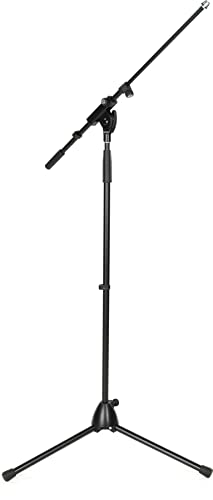
K&M 21075 telescoping one piece boom stand
German-made with metal clutches instead of plastic ones, which is the part that fails on cheap stands after a couple of years of being adjusted. The one piece telescoping boom means there is no separate arm to lose or to over-tighten.
Best for: A stand you adjust daily and expect to still own in fifteen years.
Check price
Atlas Sound MS-10C round base stand
A cast round base with real mass in it. Mass is the only thing that actually stops a stand from walking, tipping or transmitting footfall, and no amount of clever design substitutes for it.
Best for: A permanent vocal position, or a room with a suspended wooden floor.
Check pricePrices change often, confirm on Amazon. As an Amazon Associate we earn from qualifying purchases.
Should you buy a stand or a boom arm?
Decide by where you sit, not by price. They solve different problems and most working setups end up with one of each.
| Job | Correct support | Why |
|---|---|---|
| Seated voice at a desk | Clamped boom arm | No floor contact, no floor space, one movement to park it |
| Standing vocal take | Tripod euro boom | Reaches a standing mouth height with the base out of your way |
| Guitar amp, close mic | Tripod boom, short extension | Low position, heavy cable pull, needs a wide footprint |
| Acoustic guitar, seated player | Tripod boom or two | Position matters to the inch, so a fine adjustment clutch earns its money |
| Drum overheads | Tall tripod boom with counterweight | Maximum extension and maximum height at once, the hardest case |
| Vocal booth or corner | Round base | Legs will not fit, and there is nothing to trip over |
I lost a vocal take to a stand, once, in the way you only lose it once. Upstairs room, wooden floor, condenser on a light tripod with no shock mount, and the singer stepped forward on the last chorus to push the line. The step arrived at the capsule as a low thump under the best phrase of the day, and no high pass filter was going to separate a footfall from the chest resonance of the note it landed on. A shock mount costs about thirty dollars and a boom arm clamped to a desk removes the path entirely. Since then, anything on a suspended floor either gets a shock mount or gets clamped, and I have not had to have that conversation again.
What else does the microphone actually need?
A stand is one of three parts of the mount, and the other two are cheap enough that leaving them out is a false economy.
- A shock mount , about $29.99. Elastic suspension between the stand and the microphone body. Required for a condenser on a floor stand, largely optional for a dynamic.
- A pop filter . Stops the blast of air from a plosive from hitting the diaphragm. That blast is not a loudness problem, it is a displacement problem, so it cannot be fixed later with EQ.
- A cable long enough to give the stand slack. A taut XLR cable pulls a stand out of position over the course of a session, slowly enough that nobody notices until the tone has changed between takes.
Cable slack matters more than it sounds. The most common cause of "the second half of the session sounds different" is a stand that migrated an inch at a time under cable tension, and on a cardioid microphone an inch of movement at six inches of distance is an audible change in both level and proximity effect. The polar pattern chart shows how quickly off-axis response changes with angle.
Who should not buy the expert tier?
Do not buy the K&M telescoping boom at $91.00 for a stand that lives in one position. What you are paying for is metal clutches that survive daily adjustment, and if the stand gets set up once in front of an amp and then left alone, the $31.95 euro boom will do the identical job for a decade. The K&M earns its price on the stand you touch every day, not the one you touch every month.
Do not buy the Atlas MS-10C at $78.99 for a room with a concrete slab floor. Its advantage is mass, and mass buys you resistance to footfall and to being knocked. On a ground floor slab there is very little structural vibration to resist, and the same money buys a decent stand plus a shock mount plus a pop filter, which will improve more recordings.
Do not buy a second boom arm before you own a floor stand. A desk arm cannot reach a guitar amp, a drum kit or a standing singer, and every studio eventually needs to record one of those. One arm and one floor stand covers more ground than two arms at any budget.
How many stands does a home studio need?
Two, and then it stops being about stands and starts being about how many things you record at once. One desk boom arm for the voice position you use daily, and one floor boom for everything the arm cannot reach. That combination handles a vocal, an amp, an acoustic guitar and a percussion overdub without repatching.
Beyond two, stands scale with input count rather than with ambition. If your interface has two inputs, a third stand sits in a cupboard. When you move to four or eight inputs, usually because you have started recording drums, the stand count jumps sharply and tall counterweighted booms stop being optional. The interface guide covers where that threshold sits.
Related
- How to record vocals at home: where the microphone should go once it is held up
- Best vocal microphones: what goes on the end of the boom
- Best dynamic microphones: the heavy ones that need a real stand
- Home studio signal flow explained: where the mount sits in the chain
- The intermediate build: stand, arm and mount already priced in
The microphones that make the stand rating matter
Load rating stops being a specification and starts being a daily annoyance the moment you hang a heavy dynamic off a light arm. The Shure SM7B review and the Electro-Voice RE20 review both cover microphones heavy enough to defeat a cheap desk arm within weeks, which is worth reading before you decide the arm is the place to save money.
Frequently asked questions
What is the best microphone stand for a home studio?
The On-Stage MS7701B euro boom at about $31.95 for most people. The euro boom design puts a counterweight on the short end of the boom arm so the load is balanced rather than cantilevered, which is what stops a stand creeping downward with a heavy microphone at full extension. If you record voice sitting at a desk, a clamped boom arm like the Rode PSA1+ is a better answer than any floor stand.
Is a boom arm better than a microphone stand?
For desk work, yes, for two reasons. It clamps to the desk so it takes no floor space, and it decouples the microphone from footfall coming up through the floor, which is a real source of low frequency thumps in an upstairs room. A floor stand is better for anything you cannot reach from a chair: guitar amps, drums, standing vocals and any position more than about three feet from the desk.
Why does my microphone stand keep drooping?
Because a boom is a lever and yours is out of balance. The torque on the clutch is the weight of the microphone times its distance from the pivot, so a one pound microphone at two feet exerts twice the load of the same microphone at one foot. Either slide the counterweight further out, retract the boom, or move to a stand with a real counterweight. Over-tightening the clutch strips it and does not fix the physics.
Do I need a shock mount as well as a stand?
For a condenser on a floor stand in a room with a wooden floor, yes. A shock mount suspends the microphone in elastic bands so vibration travelling up the stand is damped before it reaches the capsule, and it costs about $30 against a take ruined by a footstep. For a dynamic microphone, or a microphone in a desk boom arm on a solid floor, it matters much less.
What weight of microphone can a cheap stand hold?
Roughly a pound at moderate boom extension, which covers most condensers and every handheld dynamic. The problems start above that: an SM7B with its yoke is about 1.7 pounds and a large multi-pattern condenser in a shock mount can exceed 2 pounds. At that weight a light tripod boom will creep downward over a take even when the clutch feels tight, and you will not notice until playback.
Should I buy a round base or a tripod stand?
Tripod for anything with a boom, round base for a straight vertical position in a tight space. A tripod spreads its support over a wide footprint so it resists the tipping moment a boom creates, while a round base relies on sheer weight in a small area. Round bases fit against walls and inside booths where splayed legs cannot go, which is the reason to own one.
Working out your own room and signal chain? The Home Studio Build Planner is the paid version of these pages: 8 printable worksheets you fill in with your own numbers, plus the full PDF, $29.