Best Condenser Microphone Under $300 (Eight Compared)
The best condenser microphone under $300 on pure performance is the Lewitt LCT 440 PURE at $299.00, built around a very low noise floor and a response that does not editorialise. For most home rooms the better purchase is the Audio-Technica AT2035 at $159.00, because it carries a switchable 80 Hz high pass filter and a 10 dB pad on the body while the LCT 440 carries neither, and both of those controls matter more in an untreated space than a lower noise floor does.
Definition: A condenser microphone uses a thin conductive diaphragm held at a fixed charge by 48 volt phantom power, which makes it far more sensitive and more detailed than a dynamic, and equally more sensitive to the room it is used in.
On specifications alone, the best condenser microphone under $300 is the Lewitt LCT 440 PURE at $299.00: a very low noise floor and a response that does not editorialise. For most home rooms the microphone that will actually give you better recordings is the Audio-Technica AT2035 at $159.00, because it carries a switchable 80 Hz high pass and a 10 dB pad on the body and the Lewitt carries neither.
That split is the whole argument of this page, so it is worth stating once more plainly. Below $300 the differences in capsule quality are small and the differences in usability are large. The switches on the body are what you touch every session. The noise floor is what you notice once a year, on a whispered take.
What actually changes between $99 and $299?
Two things measurably, and one thing that is harder to quantify.
Self noise falls by roughly 8 to 10 dB across the band. A budget condenser sits around 20 dB SPL A-weighted, and the quietest microphones here sit nearer 12 dB. That gap only becomes audible when the source itself is quiet: a whispered vocal or fingerpicked guitar might sit at 50 dB SPL at the capsule, and at that level an 8 dB difference in the noise floor is obvious. A belted chorus at 100 dB SPL buries both.
Controls appear on the body. The AT2020 at $99.00 has no switches at all. The AT2035 at $159.00 adds a high pass and a pad. The sE X1 S at $219.00 adds two pad positions and two filter positions. Curiously, the two most expensive microphones near the cap go back to having none, on the theory that you will filter in the DAW.
Unit to unit consistency improves, which you cannot check before buying and which is the least glamorous reason more expensive microphones are more expensive. Tighter capsule tolerances mean two units of the same model match each other, which matters if you ever want a stereo pair.
Which condenser should you buy?
Three tiers across eight microphones. The beginner tier is the sub $150 band, where the sensible choice depends on what accessories you still need. The intermediate tier is the $159 to $219 band, which is where nearly everyone should stop. The expert tier is the microphone right at the $300 cap, and the section after the cards explains who should skip it.
Condenser microphone picks under $300
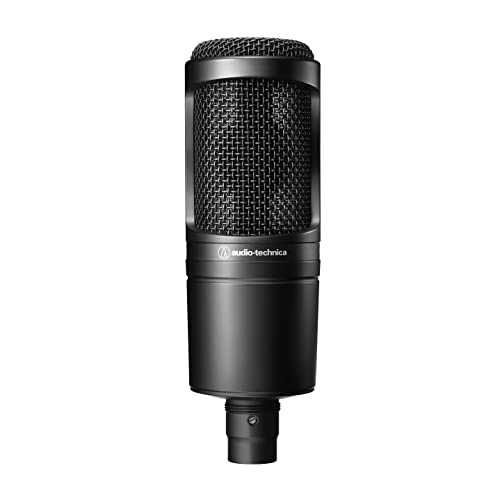
Audio-Technica AT2020
A cardioid large diaphragm condenser with a clean, slightly bright response and no controls of any kind. It is the most recommended first condenser in home recording, and the absence of a pad and a high pass filter is the reason the AT2035 exists.
Best for: A first condenser where the budget stops at a hundred dollars.
Check price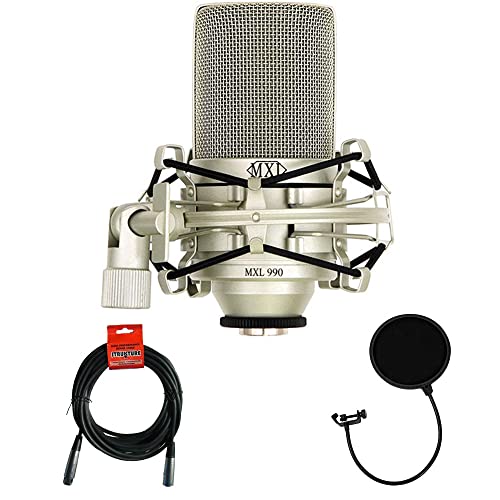
MXL 990
A gently voiced condenser that ships with a shock mount in the box, which is a genuine forty dollar saving rather than a bundled afterthought. The noise floor is higher than anything else here, which matters on quiet sources and nowhere else.
Best for: A loud source on a tight budget, where the shock mount is otherwise a separate purchase.
Check price
AKG P220
A metal-bodied AKG with a switchable 300 Hz bass cut and a 20 dB pad, which is an unusual amount of control at this money. The 20 dB pad in particular makes it usable on sources far louder than a voice.
Best for: Someone who wants one condenser to cover vocals and a loud amp.
Check price
Audio-Technica AT2035
The step up from the AT2020 buys three specific things: lower self noise, a switchable 80 Hz high pass and a 10 dB pad. The high pass is the one you use daily, because it removes rumble and proximity buildup at the capsule rather than in the mix.
Best for: Almost everyone. This is the pick if you only read one card.
Check price
Rode NT1 Signature Series (with stand)
Rode publish an unusually low self-noise figure for the NT1 line, which is the entire argument for it: a quiet microphone lets you record a quiet source without the room floor rising with it. This listing includes a stand mount.
Best for: Fingerpicked guitar, soft singers and anything recorded at a distance.
Check price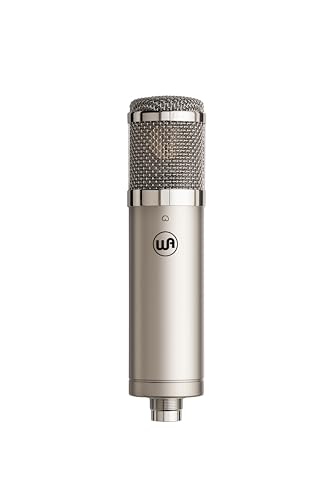
Warm Audio WA-47jr SE
A FET take on a classic large diaphragm design, deliberately coloured through the midrange, with multiple polar patterns. It is the opposite of neutral, which is the point, and it will not suit every voice.
Best for: A thin or bright voice that needs weight added at the capsule rather than in the mix.
Check price
sE Electronics X1 S
Two pad positions at 10 and 20 dB and a two position low cut, which together make it the most flexible microphone here on loud sources. A bright, forward voicing that cuts through a dense arrangement without EQ.
Best for: Drum overheads, guitar cabinets and vocals that need to sit forward.
Check price
Lewitt LCT 440 PURE
Lewitt built the LCT 440 PURE around a very low noise floor and a response that does not editorialise, so the recording sounds like the singer rather than like a microphone with an opinion. No pad and no filter on the body, which is a deliberate choice and a real limitation in a noisy room.
Best for: A quiet, treated room where you want to make the tonal decisions later.
Check pricePrices change often, confirm on Amazon. As an Amazon Associate we earn from qualifying purchases.
How do the condensers compare?
Read the pad and filter columns first. They change what the microphone can do; the character column is the one where opinions differ most.
| Microphone | Price | Patterns | High pass | Pad | Character |
|---|---|---|---|---|---|
| Audio-Technica AT2020 | $99.00 | Cardioid | None | None | Clean, slightly bright |
| MXL 990 | $99.95 | Cardioid | None | None | Gentle, higher noise floor |
| AKG P220 | $114.99 | Cardioid | 300 Hz switch | 20 dB | Solid, mid forward |
| Audio-Technica AT2035 | $159.00 | Cardioid | 80 Hz switch | 10 dB | Neutral, slight presence lift |
| Rode NT1 Signature | $196.00 | Cardioid | None | None | Very quiet, smooth |
| Warm Audio WA-47jr SE | $199.00 | Three patterns | Switch | 10 dB | Coloured, thick midrange |
| sE Electronics X1 S | $219.00 | Cardioid | Two positions | 10 and 20 dB | Bright, high SPL capable |
| Lewitt LCT 440 PURE | $299.00 | Cardioid | None | None | Neutral, very low noise |
The AKG P220 is worth a second look on that table. A 20 dB pad and a metal body at $114.99 make it the most capable cheap microphone here on loud sources, and its 300 Hz bass cut is set higher than the usual 80 Hz, which is aggressive for a vocal and useful on a boomy acoustic guitar.
Something I wish somebody had told me before I bought my third microphone: the differences between condensers in this price band are smaller than the difference between two positions six inches apart in the same room. I have spent afternoons comparing capsules and got less change out of it than from moving a singer eighteen inches away from a wall and turning them to face the long dimension. If you are unhappy with a vocal sound and you own an AT2020, the next thing to change is almost never the microphone. It is the distance, the angle, the wall behind the singer, and whether the high pass is engaged.
Why does the high pass filter matter so much at home?
Because home rooms are full of low frequency energy that has nothing to do with the performance. Traffic outside, a heat pump, footfall transmitted through the floor into the stand, and proximity effect from a directional microphone worked close. All of it lands below about 100 Hz, and all of it is captured by a condenser whose response extends flat down to 20 Hz.
Filtering at the capsule rather than in the mix has a real advantage: the rumble never reaches the preamp, so it never eats into your headroom or drives the input into a region where it behaves badly. Filtering in the DAW works fine tonally and does nothing for either of those. On a source where nothing musically important exists below 80 Hz, which is every vocal and most acoustic guitars, the switch should simply be on.
The instrument frequency range chart shows which sources have real content down there and which do not, and how to record vocals at home covers the rest of the capture chain in order.
What has to go with a condenser?
A condenser is more demanding on accessories than a dynamic, because it is more sensitive to everything.
- 48 volt phantom power, from the interface. Non-negotiable and universally available.
- A shock mount, at about $29.99 . A sensitive capsule on a rigid mount hears every footstep in the room as a low frequency thump travelling up the stand. The MXL 990 is the only microphone here that includes one.
- A pop filter, on a gooseneck , two inches in front of the capsule. A plosive is a burst of moving air rather than a loud sound, so it has to be stopped physically.
- Absorption behind the singer, which is the accessory nobody counts as one. Two 2 inch panels change more than any capsule upgrade in this band.
Who should not buy the expert tier?
Do not buy the Lewitt LCT 440 PURE at $299.00 for an untreated, noisy room. The two things it is best at, a very low noise floor and a completely neutral response, are the two things a bad room takes away from you first. A noise floor of 12 dB SPL is meaningless if the room floor is 35 dB SPL from a computer fan and the street. And with no high pass on the body, every bit of that rumble goes into the preamp.
In that situation the AT2035 at $159.00 will give you a better final recording, and the $140.00 difference buys a 2 inch panel for the wall behind the singer with change left over. Once the room is quiet and treated, the LCT 440 becomes a genuinely better microphone and you will hear the difference on quiet material.
A second exclusion that catches people: if your room is bad enough that a condenser sounds hollow and phasey no matter where you stand, no condenser under $300 fixes it. Buy a dynamic instead. The dynamic microphone roundup covers that case and condenser versus dynamic explains exactly why the room, not the voice, decides.
What to do after the microphone
Set gain from the loudest phrase in the song rather than a spoken test, aim for peaks around -10 dBFS and roughly -18 dBFS RMS, and let the verses meter low. Twenty four bits gives about 144 dB of range, so headroom costs nothing. The gain staging calculator works out what your combination needs.
Then treat the wall behind the singer and the wall behind the microphone, in that order. Size the coverage with the acoustic treatment calculator, buy from the panels roundup, and mount everything on something stable from the stands and boom arms roundup. If you are still assembling the chain, the beginner build costs the whole thing out at once.
Full reviews of the condensers here
The Lewitt LCT 440 PURE review covers the quietest capsule near the price and the complete absence of a pad or a filter on it. The Rode NT1 5th Gen review covers the dual XLR and USB output. The Audio-Technica AT2035 review covers the cheapest of the three and the two switches that make it the practical daily choice, and the AKG C214 review covers what happens when you step just above this price band.
Frequently asked questions
What is the best condenser microphone under $300?
The Lewitt LCT 440 PURE at $299.00 on pure performance: a very low noise floor and a response that does not editorialise, so the recording sounds like the source. For most home rooms the better buy is the Audio-Technica AT2035 at $159.00, because it carries a switchable 80 Hz high pass and a 10 dB pad on the body and the LCT 440 carries neither.
Is there a real difference between a $99 and a $299 condenser?
Less than the price suggests, and the difference is concentrated in two places. Self noise falls by roughly 8 to 10 dB across that range, which is audible only on quiet sources. And the more expensive microphones tend to have flatter, more consistent responses unit to unit. Frequency response differences between any two of these are far smaller than the difference between two positions in your room.
What does microphone self noise mean in practice?
It is the hiss the microphone electronics generate with no sound present, published as an A-weighted figure in dB SPL. A figure around 20 dB is ordinary and around 12 dB is very quiet. On a belted chorus at 100 dB SPL you will never hear either. On a whispered vocal or fingerpicked acoustic guitar at 50 dB SPL, an 8 dB difference in the noise floor is plainly audible.
Do I need a pad and a high pass filter on the microphone body?
In a home room, yes, and it is the most underrated pair of switches in this price band. A high pass at 80 Hz removes footfall, traffic rumble and proximity buildup before the preamp ever sees them, which is better than removing them later with EQ that also thins the voice. A 10 dB pad lets a loud singer work close without overloading the capsule electronics.
How much preamp gain does a condenser microphone need?
About 35 to 40 dB for a normal sung vocal at six to eight inches, which every interface on the market supplies comfortably. A typical large diaphragm condenser puts out around 22 mV per pascal, roughly twenty times the output of a low-output dynamic. This is the main practical reason condensers are easier to use at home, even though the room makes them harder.
Do condenser microphones need phantom power?
Yes, 48 volts, supplied over the XLR cable by your audio interface or mixer. Every interface currently sold provides it, usually on a switch marked 48V. It powers the capsule polarisation and the internal impedance converter. A dynamic microphone does not need it, and leaving it switched on does not harm a balanced dynamic, so the switch can stay on in a mixed setup.
Working out your own room and signal chain? The Home Studio Build Planner is the paid version of these pages: 8 printable worksheets you fill in with your own numbers, plus the full PDF, $29.